The End of Static Enterprise Systems
Enterprise software is undergoing a structural transition. The era in which ERP systems functioned as static systems of record got periodically upgraded, heavily customized, and operationally isolated and has effectively reached its limits.
Modern enterprises no longer compete on periodic efficiency gains. They compete on continuous responsiveness: The ability to sense, decide, and act in real time across global operations. In this context, legacy ERP architectures, regardless of their historical robustness, introduce friction in the form of latency, fragmentation, and upgrade inertia.
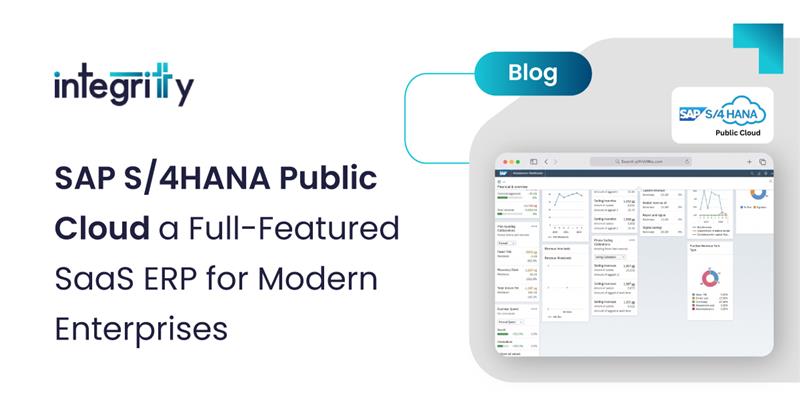
SAP Cloud ERP, delivered through SAP S/4HANA Cloud, represents a deliberate architectural departure from this legacy paradigm. It is not merely an ERP hosted in the cloud; it is a re-architected enterprise control plane, designed to unify transactional integrity with real-time intelligence.
A Unified Digital Core: From Fragmentation to Convergence
At the heart of SAP Cloud ERP lies a fundamental design principle: Convergence of execution and intelligence.
Traditional enterprise landscapes separate operational systems (ERP), analytical systems (data warehouses), and planning layers into distinct domains. This separation introduces inherent latency data that can be extracted, transformed, and reloaded before it becomes actionable.
SAP Cloud ERP eliminates this separation through an in-memory, real-time data architecture powered by
SAP HANA. The result is a unified digital core in which:
- Transactions are immediately reflected in financial and operational views
- Analytics operate directly on live operational data
- Planning and execution coexist within the same semantic model
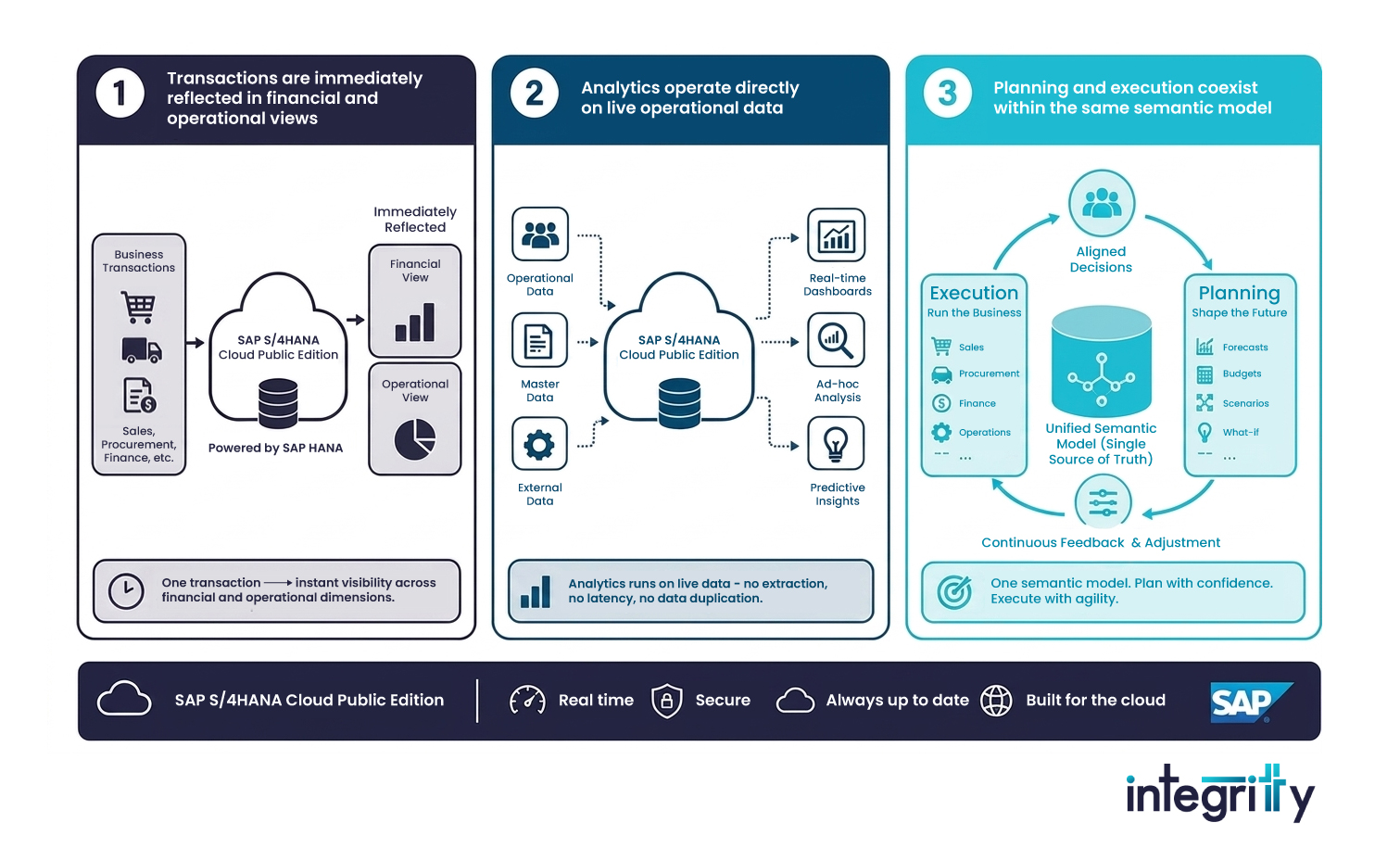
This architectural unification is not incremental; it fundamentally alters the temporal nature of enterprise decision-making, shifting it from retrospective reporting to continuous operational awareness.
This blog explores SAP Cloud ERP from a technical and architectural perspective, highlighting its core capabilities, enterprise advantages, and strategic value for modern organizations.
SAP Cloud ERP: A Cloud-Native Intelligent Core
SAP Cloud ERP is not simply a migration of legacy ERP systems into the cloud. It is a cloud-native, multi-tenant SaaS architecture built around SAP’s in-memory computing engine, SAP HANA. This architecture enables high-speed transaction processing and real-time analytics within a unified data model.
Continuous Innovation: Always-updated capabilities through seamless release cycles.
Zero “Version Lock”: No more disruptive upgrade projects under a SaaS delivery model.
Real-Time Visibility: One unified, real-time source of truth across the enterprise.
At its core, SAP Cloud ERP integrates operational and analytical workloads into a single system, eliminating the need for separate reporting layers or data warehouses for operational intelligence.
Key architectural principles include:
- In-Memory Computing (SAP HANA): Enables real-time processing of large transactional datasets with minimal latency.
- Single Source of Truth: Ensures consistent, harmonized data across finance, supply chain, procurement, and sales.
- Cloud-First Deployment Model: Supports scalability, elasticity, and reduced infrastructure dependency.
- Continuous Delivery Model: Delivers quarterly or biannual updates without disruptive upgrade projects.
Process Architecture as an Enterprise Value System
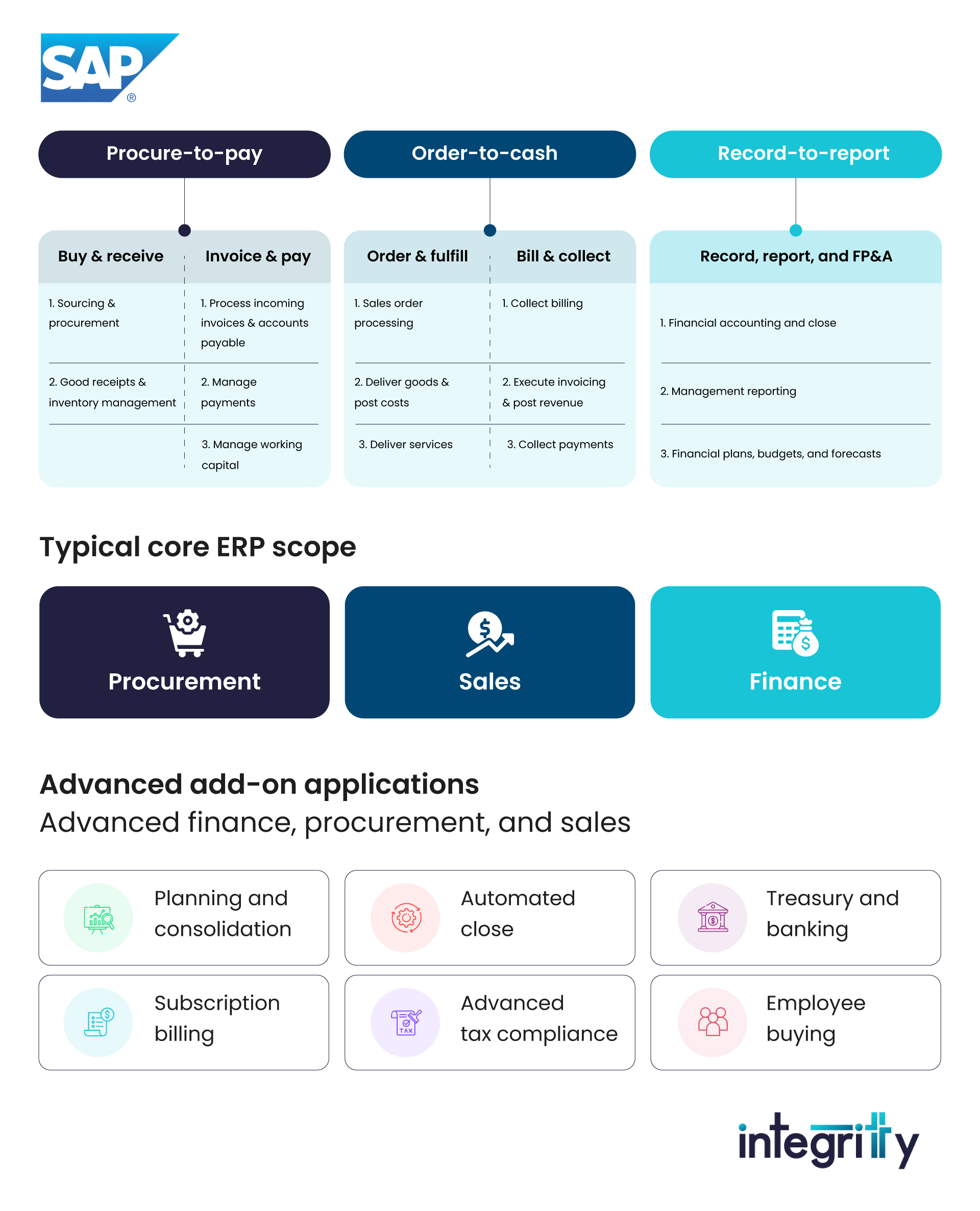
Rather than viewing ERP as a collection of modules, SAP Cloud ERP should be understood as a process orchestration system, structured around three foundational value streams that define enterprise performance:
- Source and Supply (Procure-to-Pay)
- Sell and Fulfill (Order-to-Cash)
- Record and Govern (Record-to-Report)
Procure-to-Pay (P2P): Intelligent Procurement and Supplier Orchestration
The Procure-to-Pay cycle in SAP Cloud ERP represents a fully digitized and automated procurement lifecycle that spans sourcing, purchasing, receiving, and payment execution. From a technical standpoint, SAP enables end-to-end orchestration of procurement workflows using embedded business rules, machine learning, and supplier network integration.
Core capabilities include:
- Strategic sourcing with supplier lifecycle management
- AI-assisted supplier recommendation and risk evaluation
- Automated purchase requisition and approval workflows
- Real-time inventory integration with Materials Management (MM)
- Invoice matching through three-way validation (PO, GRN, Invoice)
SAP Ariba integration further extends procurement capabilities into a global supplier network, enabling collaborative commerce and improved spend visibility.
Business impact:
- Reduced procurement cycle time through automation
- Improved compliance through rule-based approvals
- Enhanced spend transparency and cost optimization
Order-to-Cash (O2C): Revenue Lifecycle Optimization
The Order-to-Cash process in SAP Cloud ERP governs the entire revenue generation lifecycle from order creation to cash collection. It is tightly integrated with logistics, inventory, pricing, and finance modules.
SAP’s SD (Sales and Distribution) framework is enhanced in the cloud ERP model with real-time availability checks and intelligent fulfillment optimization.
Core capabilities include:
- Real-time order processing with ATP (Available-to-Promise) checks
- Dynamic pricing and contract management
- Integrated logistics execution and shipment tracking
- Automated billing and invoicing
- Credit management and risk scoring
- By leveraging embedded analytics, organizations can identify bottlenecks in fulfillment and proactively optimize revenue cycles.
Business impact:
- Faster order fulfillment and revenue recognition
- Reduced billing errors and disputes
- Improved customer satisfaction through accurate delivery commitments
Record-to-Report (R2R): Real-Time Financial Intelligence
Record-to-Report represents the financial backbone of SAP Cloud ERP, enabling organizations to maintain high-integrity financial records while supporting real-time analytics and compliance. Unlike traditional finance systems that rely on batch processing, SAP S/4HANA Finance operates in real time, allowing immediate financial consolidation and reporting.
Core capabilities include:
- Universal Journal architecture (ACDOCA) consolidating financial and controlling data
- Real-time general ledger posting and reconciliation
- Automated financial closing and consolidation processes
- Integrated asset accounting and cost center accounting
- Advanced FP&A (Financial Planning & Analysis) capabilities
The system supports compliance with global accounting standards such as IFRS and GAAP while enabling continuous close processes.
Business impact:
- Reduced financial closing cycles (fast close or continuous close)
- Improved accuracy and auditability of financial data
- Real-time profitability and cost analysis
Embedded Intelligence: The Shift from Systems of Record to Systems of Action
The defining evolution in SAP Cloud ERP is not only architectural but also cognitive. The platform increasingly behaves as a system of action, where insights are not merely generated but operationalized. Through embedded machine learning models and rule-based automation, the system continuously evaluates operational patterns, identifies anomalies, and recommends or executes corrective actions.
This introduces three critical shifts:
- From descriptive to predictive operations, anticipating disruptions before they materialize
- From manual execution to autonomous workflows, reducing human intervention in routine decisions
- From static reporting to adaptive systems behavior, where processes evolve based on observed outcomes
Enterprise systems thus become responsive entities rather than passive repositories.
SaaS Transformation: From Ownership to Continuity
Beyond Core ERP: Tailored for Your Industry
SAP Cloud ERP is not a one-size-fits-all solution; it is designed to address the inherent complexity and variability of modern industry landscapes. Built on a flexible yet standardized core, it enables organizations to align enterprise operations with sector-specific requirements without compromising system integrity or scalability.
Industry Applicability
Whether an organization operates in High-Tech Manufacturing with complex, multi-tier supply chains, Professional Services requiring precise project-based billing and resource utilization, or the Public Sector with a strong emphasis on transparency, compliance, and accountability, SAP Cloud ERP delivers industry-specific best-practice templates that accelerate deployment and reduce implementation risk.
These pre-configured industry models allow enterprises to adopt proven process frameworks while maintaining the ability to adapt to evolving business needs.
Advanced Capabilities
SAP Cloud ERP extends beyond traditional transactional capabilities by embedding next-generation digital intelligence into core business processes:
- AI-Driven Insights: Embedded artificial intelligence enables continuous pattern recognition, predictive analytics, and automation of routine operational tasks, supporting faster and more informed decision-making.
- Sustainability Tracking: Integrated ESG (Environmental, Social, and Governance) reporting capabilities ensure organizations can monitor, measure, and comply with evolving global sustainability and regulatory requirements.
Integritty’s Perspective: ERP as a Strategic Operating Model
“ERP success today is defined by adaptability without compromising core standardization.”
From an implementation standpoint, ERP transformation should not be interpreted as a technical migration. It is fundamentally an operating model redesign initiative. The value of SAP Cloud ERP is fully realized only when organizations rethink how processes, data, and decision flows interact.
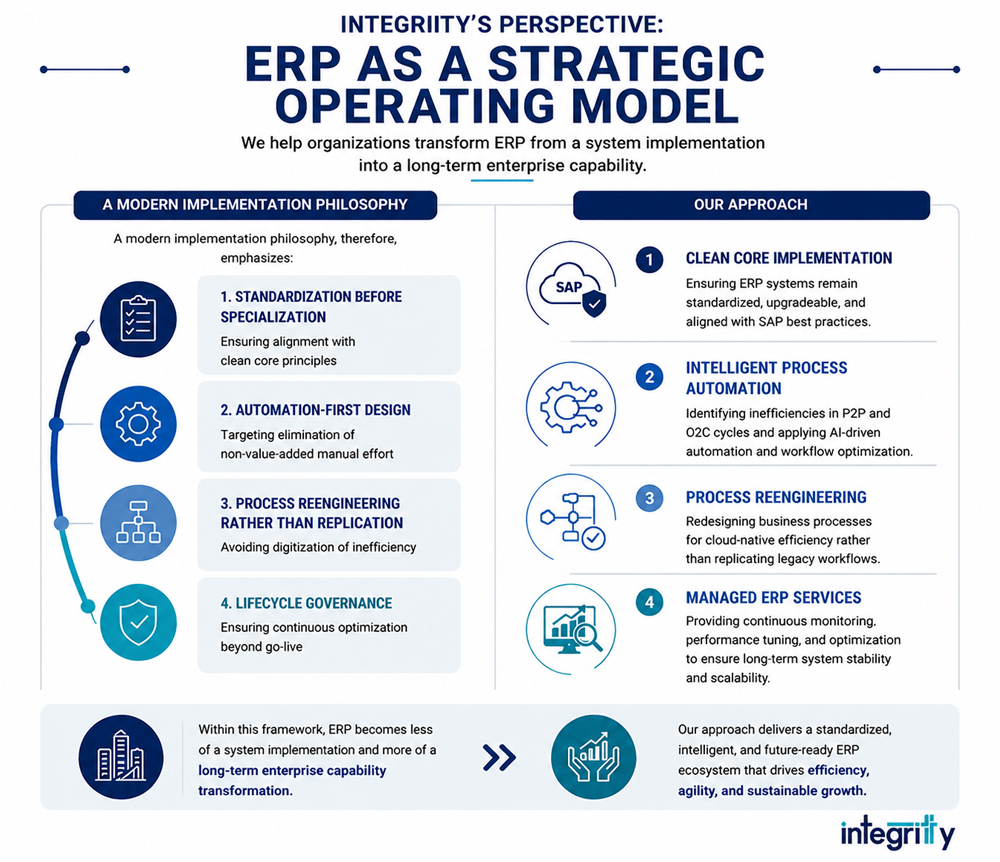
A modern implementation philosophy, therefore, emphasizes:
- Standardization before specialization, ensuring alignment with clean core principles
- Automation-first design, targeting elimination of non-value-added manual effort
- Process reengineering rather than replication, avoiding digitization of inefficiency
- Lifecycle governance, ensuring continuous optimization beyond go-live.
Within this framework, ERP becomes less of a system implementation and more of a long-term enterprise capability transformation.
Our approach includes:
Clean Core Implementation: Ensuring ERP systems remain standardized, upgradeable, and aligned with SAP best practices.
Intelligent Process Automation: Identifying inefficiencies in P2P and O2C cycles and applying AI-driven automation and workflow optimization.
Process Reengineering: Redesigning business processes for cloud-native efficiency rather than replicating legacy workflows.
Managed ERP Services: Providing continuous monitoring, performance tuning, and optimization to ensure long-term system stability and scalability.
Conclusion
SAP Cloud ERP represents the future of enterprise management, combining the depth and functionality of a full-featured ERP system with the speed, agility, and scalability of a modern SaaS platform. It unifies mission-critical business processes into a single intelligent digital core, enabling organizations to operate with greater precision and real-time visibility.
By integrating core enterprise processes such as procure-to-pay, order-to-cash, and record-to-report, SAP Cloud ERP establishes a cohesive and standardized foundation for end-to-end business execution. This integration enhances operational consistency, improves financial transparency, and enables a continuous flow of data across the enterprise landscape.
For organizations looking to modernize their digital core, SAP Cloud ERP stands as the strategic choice for building a resilient, intelligent, and future-ready enterprise, capable of adapting to evolving market demands while driving sustained long-term growth.